

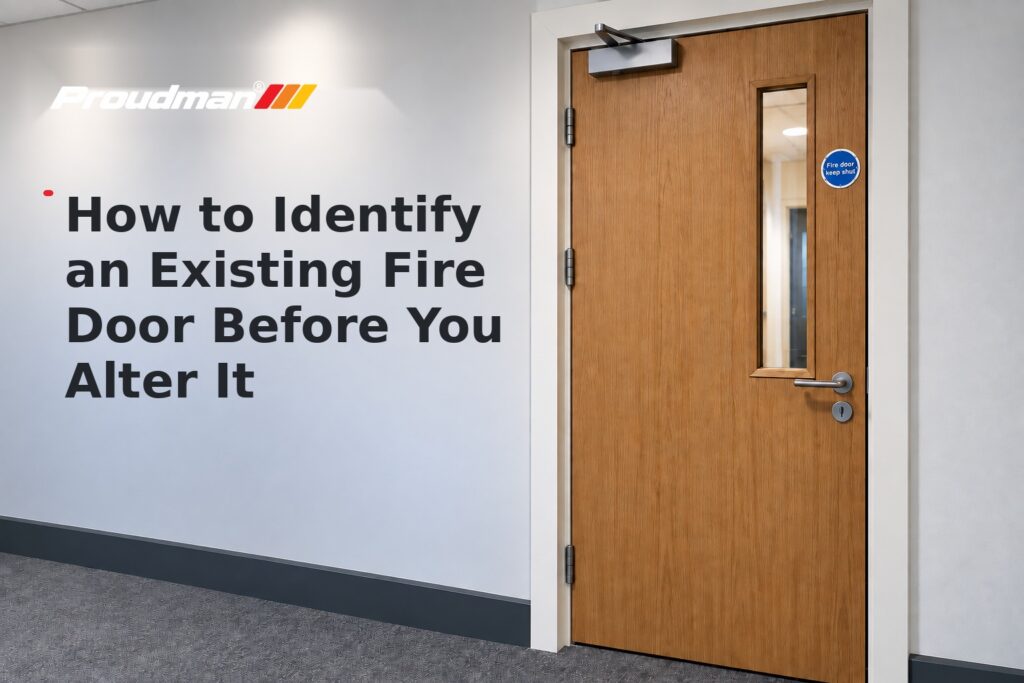
Before you alter an existing fire door, you need to know exactly what you are working on.
This is something I have become increasingly aware of over the years.
A lot of people see a door that looks like a fire door and immediately start thinking about what needs changing.
A new lock.
A new closer.
Moving a hinge.
Planing the edge.
Adjusting the frame.
Fitting access control.
Replacing hardware.
But before you start altering anything, I think there is a much more important question:
What exactly is this door?
I don’t mean simply whether it looks like a fire door.
I mean how it was constructed, what it was designed to do, what information exists about it, whether that information actually relates to the door in front of you and what the building’s fire strategy requires from it.
That is where I start.
Start with the building
The first thing I want to understand is not necessarily the door.
It is the building.
I want to know what the fire strategy says and why that particular opening needs a fire-resisting door.
A fire door doesn’t exist in isolation.
It forms part of the building’s overall fire safety arrangements.
So I want to understand what the door is protecting.
Is it protecting an escape route?
Is it part of compartmentation?
Is it separating different areas of the building?
Is it protecting a particular room?
Or has somebody simply assumed that because it looks like a substantial door, it must be a fire door?
This is why I always want to see the fire strategy and fire risk information where it is available.
I also want to understand whether the building has changed since the original information was produced.
Buildings get altered.
Walls get moved.
Rooms get created.
Floors get added.
Uses change.
Doors get added.
And sometimes the paperwork doesn’t keep up with the building.
So before I start making decisions about an individual door, I want to understand the building it is actually sitting in today.
Check the paperwork
Once I understand the building, I want to see what information exists for the door.
That could include:
- O&M manuals
- Fire door schedules
- Drawings
- Installation information
- Manufacturer information
- Certification
- Test or assessment information
- Previous inspection records
- Maintenance records
- Refurbishment information
But there is an important point here.
I don’t automatically assume that the paperwork is correct just because it is in an O&M manual.
I compare it with what is actually on the building.
Does the manufacturer match?
Does the door construction match?
Does the frame match?
Does the configuration match?
Does the hardware match?
Does the size match?
Does the information actually relate to this building?
I have seen situations where it doesn’t.
And when it doesn’t, the paperwork can raise more questions than it answers.
Look for labels, plugs and identification
I always look for anything that could help identify the door.
That might be a manufacturer’s label.
It could be a plug or disc.
There could be a reference number or other identification mark.
If I find one, I photograph it and record the information.
But again, I don’t just see a label and assume everything is sorted.
I want to know what that identification relates to.
If there is a certificate or manufacturer’s information associated with it, does that information actually describe the door I am looking at?
A label is useful evidence.
It isn’t a magic ticket that automatically proves the door is suitable.
Then I look at the actual door
This is where my experience as a joiner becomes particularly useful.
I want to see how the door has actually been made.
I look at the door leaf.
I look at its thickness.
I look at the construction.
I look at the ends of the door.
I look for construction joints.
I look at the lippings.
Where the construction is visible, I look to see what I can establish about the core.
I look at the workmanship.
I look for modifications.
I look for repairs.
I look for anything that doesn’t look original.
Sometimes you can learn a lot about an old door simply by looking carefully at how it has been manufactured.
I’ve also tapped doors to get an indication of how they are constructed.
That isn’t a fire test and I would never claim that tapping a door proves its fire resistance.
It doesn’t.
But as part of a wider inspection, it can give you another piece of information about the construction.
I’m building up a picture.
Look at the frame as well
The door leaf is only part of the doorset.
I also want to understand the frame.
I look at the frame construction.
I look at the material.
I look at the dimensions.
I look at the rebate.
I look at the relationship between the door and frame.
I look at the gaps.
I look at the workmanship.
I want to know whether the frame and door appear to belong together as a doorset.
Again, I’m not trying to establish a fire rating simply by taking a measurement.
I’m looking for evidence that helps me understand what I am actually dealing with.
Check the ironmongery
Then I look at the ironmongery.
Hinges.
Locks.
Latches.
Closers.
Handles.
Fixings.
Fixing locations.
Glazing.
Anything else that forms part of the doorset.
I don’t just look at whether the component is present.
I look at what it is and how it has been fitted.
For example, with hinges I want to know what type they are, how many there are, where they are positioned and how they have been fixed.
With locks and latches, I want to understand what has been fitted and whether it appears appropriate for the door.
With closers, I want to see what has been installed and how it is working.
A fire door isn’t just a piece of timber.
The components and the way they are installed form part of the overall doorset.
Check the seals carefully
This is another area where you need to look rather than assume.
A brush strip doesn’t automatically mean you have an intumescent brush seal.
I have seen this first-hand.
On one seven-storey government building I inspected, the doors had push-in, barbed brush strips.
They looked like something that could easily be assumed to be a fire-door seal.
But when I looked closely, they were simply brush strips.
There was no intumescent material in them.
That made me investigate the doors much further.
It is very easy to look at something that appears to be in the right place and assume that it is doing the job you expect it to do.
With fire doors, I don’t think that is good enough.
You need to establish what you are actually looking at.
Don’t automatically reject an old door
This is important.
I am not saying that an old fire door is automatically unsuitable.
It isn’t.
Older doors were made differently from many of the doors we see today.
Some older doors can still be suitable.
Some may not have modern certification.
Some may not have the same visible features you would expect to see on a modern doorset.
Some older doors were even manufactured with intumescent material positioned behind the door lippings.
So I don’t believe in looking at an old door and immediately saying:
“It doesn’t look like a modern fire door, so it must be wrong.”
That is far too simplistic.
What I want to know is what the door actually is, how it was constructed, what evidence exists for it and whether it remains suitable for what the building requires.
Photograph everything before you alter it
If I’m going to alter an existing fire door, I want a record of what was there before I started.
I would photograph:
- The complete door
- Both sides where appropriate
- The door edges
- Labels
- Plugs
- Seals
- Hinges
- Locks
- Closers
- Handles
- Glazing
- The frame
- Fixings
- Any unusual construction
- Any existing damage or modifications
If there is a manufacturer’s mark, I want a clear photograph of it.
If there is something unusual, I photograph that too.
Once you alter a door, you have changed the evidence.
So get your photographs first.
Don’t destroy evidence before you understand it
This is particularly important with older doors.
If I find something unusual, I don’t automatically remove it because I think it looks wrong.
I investigate it.
Older doors can contain construction methods that aren’t common on modern doors.
Something unfamiliar isn’t automatically defective.
The same applies to identification marks.
If you remove something that turns out to have been the only way of identifying the door, you’ve just made your investigation harder.
So before removing, drilling, cutting or modifying anything, take a step back.
Work out what you are looking at first.
What about the frame-to-wall junction?
Another area that needs consideration is the junction between the frame and the wall.
A lot of this is hidden behind the architrave.
If I haven’t removed the architrave, I may not know exactly what is behind it.
That is different from knowing that there is no fire stopping.
Unknown isn’t the same as defective.
But if the architrave is removed as part of an investigation or other work and I can actually see that there is no appropriate fire stopping at the frame-to-wall junction, then I have found something.
I can’t simply put the architrave back and pretend I haven’t seen it.
It needs to be dealt with appropriately.
This is why I think there needs to be some common sense about intrusive inspection.
You don’t necessarily start taking every architrave off every fire door just to see what is behind it.
But if something is opened up, what you find matters.
Check that the paperwork actually belongs to the door
This is probably one of the biggest lessons I have learnt.
I once investigated a seven-storey government building where the doors had apparently been passing inspections for years.
When I found the problems with the brush strips, I wanted to understand the history.
So I asked for the O&M information.
The original joinery company no longer existed.
The original door manufacturer no longer existed.
But the biggest problem was that the doorset information in the documentation did not match what was actually installed.
The information was for another job.
Not one door in the building matched the configuration shown in the paperwork.
That meant I couldn’t simply rely on the O&M manual to tell me what the doors were.
I had to investigate the actual doors.
I looked at their construction.
I looked at the frames.
I looked at the hardware.
I looked at the seals.
I looked at the dimensions.
I sought specialist advice.
There was even discussion about fire testing one of the doorsets to try to establish more information about its performance, although that testing never materialised.
My job was to investigate the evidence and present what I found.
The building’s responsible people then made their own decision about what they wanted to do.
That is how I think this type of investigation should work.
Identify the door before you alter it
For me, it comes down to a fairly simple process.
Look at the building.
Look at the fire strategy.
Check what has changed.
Check the O&Ms.
Check the drawings and schedules.
Look for labels and plugs.
Look at the actual construction.
Check the frame.
Check the ironmongery.
Check the seals.
Photograph everything.
Then decide what you are actually dealing with.
Only after that would I start altering the door.
Because once you drill it, cut it, plane it, change the hardware or alter the frame, you have changed something.
And you need to know what you are changing before you start.
I’ve seen enough fire doors over the years to know that what looks obvious from five feet away isn’t always what it appears to be when you start investigating it.
So my advice is simple:
Don’t just look at the door.
Understand the door.
Understand the building.
Understand the paperwork.
And most importantly:
Make sure the paperwork and the door are actually talking about the same thing.
Once an existing door has been identified, its condition still needs to be assessed before alteration. If you find problems with closing, gaps, hinges or other components, use the Fire Door Fault Finding guidance before deciding what remedial work is appropriate.
Related Proudman guides