

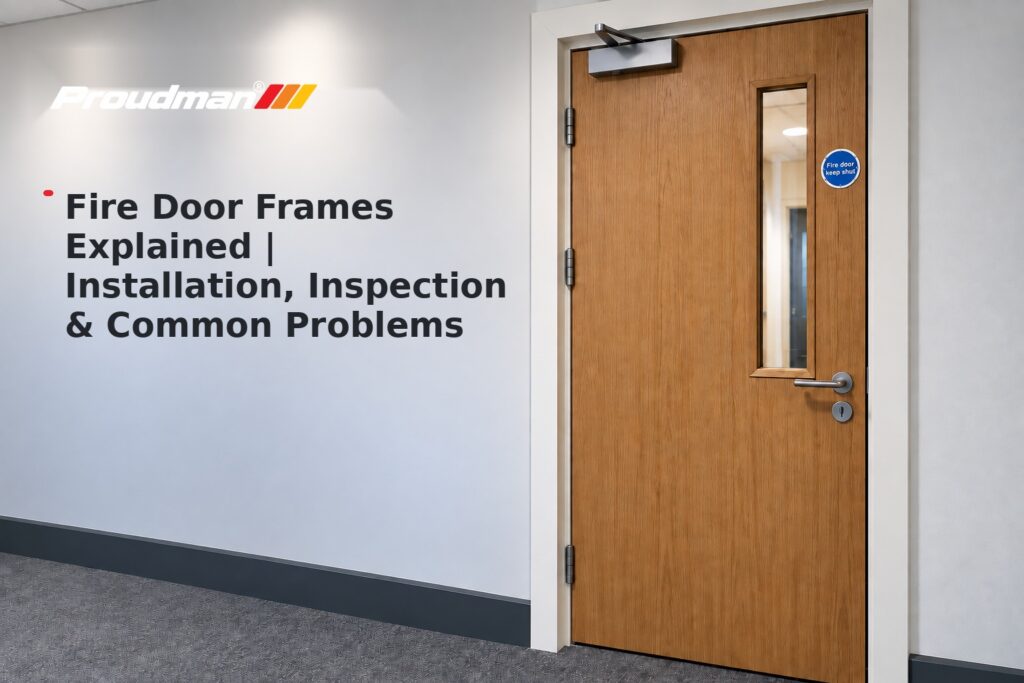
Fire Door Frames Explained | Installation, Inspection & Common Problems
A fire door frame is not simply a piece of timber around the door leaf. It is part of the doorset and establishes the geometry around the leaf while transferring the loads from the door, hinges and hardware into the surrounding construction.
One principle is important throughout this guide: the door leaf is a solid, rigid rectangle. The frame is the component that can move, twist, bow, rack, taper or become misaligned around it.
That distinction matters when diagnosing a fire door problem. An uneven gap does not automatically mean that the door leaf has changed shape. The frame, its fixings, its packing or the surrounding wall may have moved.
What is a fire door frame?
The frame provides the opening into which the fire door leaf closes. It carries the hinges, provides the closing and latching relationship, supports seals where specified, and connects the doorset to the surrounding construction.
A frame normally consists of two jambs and a head, although the exact construction varies between doorsets. The frame must be installed in the arrangement supported by the particular manufacturer’s documentation and its relevant test, assessment or certification evidence.
There is no universal installation detail that can simply be copied from one doorset to another. Frame material, construction, fixing method, packing, wall construction and fire performance all need to be considered together.
The door leaf is the fixed geometric reference
When looking at frame problems, it is useful to treat the door leaf as a solid rectangular reference. The leaf itself does not taper, twist or rack to follow a distorted frame.
If the frame moves, the relationship between the rectangular leaf and the frame changes. That can produce an uneven gap, a tight corner, a tapered jamb gap, an uneven head gap, excessive clearance at the bottom or difficulty with the latch.
This is why altering the leaf should not automatically be the first response to an unusual gap.
How the frame can move
A frame can move in several different ways. It may move at a fixing, move with the surrounding wall, bow between fixing points, twist out of plane, rack so that its geometry is no longer square, or develop a taper through one of the jambs or the head.
Movement does not necessarily mean that the frame is visibly loose.
- A fixing can move in the supporting material.
- A packer can become displaced or compressed.
- The surrounding wall or partition can move.
- The frame can be pulled out of its intended position during installation.
- Previous remedial work can have forced the frame into an unnatural position.
- Repeated loading from the door can expose weakness in the fixing or support arrangement.
The important question is not simply whether the frame feels loose. The question is whether its geometry is still correct.
Check the frame geometry
When investigating a problem, look at the relationship between the rectangular door leaf and the frame at the top, middle and bottom.
Check both jambs and the head rather than concentrating only on the location where the problem first became obvious.
- Is either jamb changing position through its height?
- Is the head level and correctly related to the jambs?
- Are the gaps consistent with the requirements for the particular doorset?
- Is one part of the frame tight while another part is open?
- Does the pattern suggest bowing or tapering?
- Are the hinge positions still correctly aligned?
- Does the latch meet the keep correctly?
- Are there signs of movement around fixings?
- Is the frame-to-wall connection sound?
A single measurement can tell you what the gap is. The pattern of measurements can help you understand why it is like that.
Common frame movement patterns
Frame bowing
If a jamb is closer to the leaf at the top and bottom but further away through the middle, the frame may have bowed. The reverse pattern can also occur.
The important point is that the frame can move between its fixing points. The timber is not necessarily moving as one rigid object.
Frame taper
A tapered gap can occur when the frame has changed position progressively through its height or when the head and jamb relationships are no longer correctly aligned.
Do not assume that a tapered gap means the door leaf needs to be cut. Establish the condition of the frame first.
Frame racking
Racking occurs when the frame loses its intended rectangular geometry. One part of the frame can move relative to another, changing the relationship between the head and jambs.
A racked frame can affect gaps, hinge alignment, latching and closing behaviour even though individual pieces of timber may appear sound.
Frame twist
A frame can also move out of its intended plane. This can make the door appear to fit differently at different points even though the leaf itself remains a rigid rectangle.
Twist can be difficult to diagnose from one measurement. Compare the frame and leaf relationship at several positions.
Why the fixing and packing arrangement matters
The frame is only as stable as the connection between the frame, its fixings, its packing and the surrounding construction.
Check for:
- missing or displaced packers
- crushed packing
- incorrectly positioned packing
- fixings that have moved
- damaged timber around fixing points
- fixings made into unsuitable supporting material
- evidence that the frame has previously been forced into position
Falcon’s installation guidance illustrates the importance of correctly locating, packing and fixing the frame. The exact fixing and packing arrangement must always follow the documentation for the doorset being installed.
The surrounding wall can affect the frame
The frame does not exist independently of the building. It is connected to a wall, partition or other supporting construction.
If that construction moves, settles or changes condition, the frame can move with it.
When investigating unexplained frame movement, look at the frame-to-wall interface as well as the frame itself. Check for cracking, disturbed finishes, loose connections, movement around fixings and evidence of previous work.
A frame that has moved may be responding to movement elsewhere in the construction rather than being the original source of the problem.
Check the hinge jamb carefully
The hinge jamb deserves particular attention because the hinges transfer the load of the door leaf into the frame.
Inspect the hinge positions, hinge fixings, timber around the hinge recesses and the condition of the frame. Look for movement, damage and evidence of previous repairs.
But do not automatically blame the hinge. A perfectly serviceable hinge can be attached to a frame that has moved.
Separate the two questions: is the hinge itself sound, and is the frame still in the correct position?
Check the latch jamb
The latch side often makes frame movement obvious because the latch and keep have to remain correctly aligned.
If the latch no longer lines up with the keep, do not automatically alter the hardware. First establish whether the latch jamb or the surrounding frame has moved.
Look at the jamb through its full height and compare the gap between the leaf and frame. A latch problem can be the visible symptom of a geometry problem elsewhere.
Frame head movement
The head provides another important geometric reference.
Check whether it remains correctly aligned with both jambs and whether the head gap is consistent with the requirements for the doorset.
An uneven head gap does not necessarily mean that the head itself has moved. One or both jambs may have changed position.
Uneven door gaps: do not immediately alter the leaf
If a gap is tight at one end and wider at another, resist the temptation to immediately plane or otherwise alter the door leaf.
First investigate the complete doorset.
- Check the frame.
- Check the hinge positions and fixings.
- Check the frame fixings and packing.
- Check the surrounding construction.
- Check for previous remedial work.
- Check the head and both jambs.
- Check the gap pattern at several points.
Only after the cause has been established should any remedial action be considered, and any alteration must remain within the requirements and evidence supporting the particular doorset.
Previous remedial work can hide the original problem
Older doorsets may contain wedges, unusual packing, excessive mastic, repaired timber, damaged fixing areas or other signs of previous adjustment.
These can be clues that somebody has already tried to correct a frame or door problem.
A previous correction can itself become part of the problem. Do not assume that an unusual fixing or packing arrangement is correct simply because it has been there for a long time.
Frame adjustment changes the whole doorset geometry
Moving one part of a frame can affect several other relationships.
- head gap
- hinge-side gap
- latch-side gap
- bottom clearance
- hinge alignment
- latch alignment
- closing action
You are not moving one piece of timber in isolation. You are changing the geometry of the doorset.
For that reason, frame correction should not be treated as a casual correction. Understand what has moved, why it has moved and what the proposed adjustment will change before carrying it out.
When a frame problem becomes a fire-door problem
Frame movement can affect the performance of the complete doorset. A change in geometry can alter the gaps, sealing arrangement, closing action, latch engagement and relationship between the leaf and frame.
A doorset should therefore be considered as a complete assembly rather than a collection of unrelated components.
The frame, leaf, hinges, hardware, seals, closer, fixings and surrounding construction all need to remain compatible with the particular doorset and its supporting evidence.
What to check during an inspection
- Door leaf: treat the leaf as the solid rectangular reference and inspect its condition.
- Hinge jamb: check position, fixings, hinges and surrounding timber.
- Latch jamb: check plumb, gaps and latch/keep relationship.
- Head: check alignment and head gap.
- Top, middle and bottom: compare the geometry rather than relying on one point.
- Fixings: look for movement, damage or unsuitable support.
- Packers: check that they remain correctly positioned and provide the intended support.
- Frame-to-wall connection: inspect the surrounding construction for movement or damage.
- Previous work: look for signs of forced correction or repair.
- Complete operation: check the door opens, closes and latches correctly.
Common frame problems at a glance
| What you see | What to investigate |
|---|---|
| Gap tight at one end and wider at the other | Frame taper, racking, hinge movement and alignment |
| Gap wider through the middle | Possible frame bowing between fixing points |
| Uneven head gap | Head alignment and movement of either jamb |
| Latch missing the keep | Latch jamb position, frame geometry and hinge relationship |
| Door binding | Frame movement, hinge condition, gaps and alignment |
| Frame feels secure but geometry is wrong | Fixing positions, packing and surrounding construction |
| Repeated previous repairs | Look for the underlying cause rather than another surface correction |
Frame inspection is about finding the cause
The most useful question is not simply, “What part looks wrong?”
It is, “What has moved, and why?”
Start with the geometry. Treat the door leaf as the solid rectangular reference and examine how the frame relates to it. Then work outward through the hinges, fixings, packing and surrounding construction.
This approach helps prevent a common mistake: correcting the visible symptom while leaving the underlying frame problem in place.
Final checks after any frame work
After the frame has been inspected or adjusted, recheck the complete doorset rather than only the original problem.
- Check the head.
- Check both jambs.
- Check the gaps.
- Check the hinges.
- Check the latch and keep.
- Check the closing action.
- Check the seals where applicable.
- Check the frame-to-wall connection.
- Confirm that the final arrangement remains consistent with the doorset manufacturer’s requirements and supporting evidence.
If you change one part of the frame geometry, something else may change with it.
The key principle
The door leaf is a solid, rigid rectangle. The frame is the component that can move around it.
Once that is understood, many apparently complicated fire-door problems become easier to investigate. A tapered gap, uneven head gap, tight lock side, excessive bottom clearance or latch misalignment can all be clues about how the frame has moved.
Find the movement first. Then determine the appropriate corrective action using the requirements for the particular doorset.
Related Proudman guides
- Why Fire Door Frames Move
- How to Inspect and Measure Fire Door Gaps
- Fire Door Hinges
- Fire Door Installation
- Fire Door Frame Problems
Related subject: Fire Door Frames.